PARALLEL GUIDE 21
Paul’s Theology, Part I
Paul’s Letters and Paul in Acts
Paul’s Theology, Part I
Paul’s Letters and Paul in Acts
Summary
Paul is a key figure in the history of the growth and spread of Christianity. Our knowledge of his work comes from the Book of Acts and from his letters. This chapter introduces Paul in his cultural setting, a society based upon motivation through honor and shame manifested through a system of patronage. It also examines our sources and discusses the literary style of the written works attributed to him. Finally, there is an introduction to the theology of Paul which was never systematic, but nevertheless bears a certain order and structure.
Learning Objectives
• Discover how letters were used to communicate in the early church and the Roman Empire
• Learn the style letter-writers used in the early church
• Identify the different kinds of epistles attributed to Paul and why some may have had other authors or at least other scribes
• Learn the criteria for deciding which epistles might be Pauline and which might have only been attributed to him but have different authors
• Understand the importance of an honor/shame ethic and the practice of patronage in the Roman society
• Learn how Christianity questioned the Roman system of patronage
Assignment to Deepen Your Understanding
Paul, in part, was giving advice to communities that were in conflict. Consider how you would write a letter to a church you know to be in conflict. What would you say to its members? How would our style differ today? What would modern technology do to the message?
Preparing for Your Seminar
Come to the seminar ready to discuss the honor/shame ethic and the role of patronage in Roman society. How is this system reflected in our society today? How is it reflected in other cultures? What is your position on this?
Works Cited
The texts of the various epistolary theorists are all conveniently available in the Loeb Classics series; or you may look at relevant extracts in Abraham J. Malherbe, Ancient Epistolary Theorists, SBL, Sources for Biblical Study 19 (Atlanta: Scholars Press, 1988).
287
Johan C. Beker, Heirs of Paul: Paul’s Legacy in the New Testament Church Today (Minneapolis, Fortress Press, 1991).
David G. Meade, Pseudonymity and Canon (Grand Rapids: Eerdmans, 1986).
288
PAUL’S THEOLOGY, PART I—
PAUL’S LETTERS AND PAUL IN ACTS
PAUL’S LETTERS AND PAUL IN ACTS
Cultural Setting
Paul lived in a world that valued letters and had highly developed the art of writing them. Archaeologists have unearthed thousands of letters of the period, scribbled on papyri or fragments of clay and dealing with every imaginable kind of personal, family, and business matter. It is clear that others—philosophers, statesmen, and poets, for example—wrote letters as an art form, intended not merely for their correspondents but also for posterity. Horace, Seneca, and Cicero all produced such letters. We must be careful, however, not to make too sharp a distinction between the literary epistle and the ordinary letter. In that age, as in our own, there were rules of correspondence, and books of rhetoric gave advice and instruction on the norms for various types of letters: the exhortatory (“paraenetic”) letter, the affectionate letter, and so on. Epicurean and Jewish groups used letters for instruction, propaganda, and for commending members to other communities. Such letters, though not written for posterity, were by design public letters. They were often composed with elegance and a sense of occasion.
The letters attributed to Paul in the New Testament all appear to be real letters, written for particular correspondents in particular situations, rather than simply with an eye on posterity. Yet they do not lack in literary quality. Without exception, they show care in composition. Evidently the author took them very seriously. Apparently, so did their recipients—as is evident from the fact that they kept them.
The Pauline correspondence seems generally intended to be read aloud in the community (1 Thess. 5:27; cf. 2 Thess. 2:2, 15), and even perhaps to be exchanged between communities (Col. 4:16). Most commonly the author writes as Paul, the apostle or servant (slave) of Jesus Christ (Rom. 1:1; 1 Cor. 1:1; 2 Cor. 1:1). In other words, the Pauline letters express Paul’s consciousness of his apostolic authority—that when he writes, he writes with and for the church. One sign of this is that often the letters are not written in his name alone. Their authorship is linked with some other member of the Christian community (1 Cor. 1:1; 2 Cor. 1:1; Phil. 1:1; 1 Thess. 1:1). Even in the note to Philemon he writes in company with “Timothy our brother” (Philem. 1).
Like all letters, the Pauline correspondence is a substitute for personal presence. This is mentioned on a number of occasions. Second Thessalonians recalls what had happened “when we were with you” (2 Thess. 3:10). Second Corinthians speaks of writing because the pain of presence would be unbearable (2 Cor. 2:1-4). In 2 Corinthians 10:1-2 the readers are also reminded that Paul says by letter what he will, if necessary, carry out when present. The letter to the Galatians expresses frustration that correspondence is only a poor substitute for presence in a difficult situation (Gal. 4:20).
There was no postal service in the Roman Empire (or at least none that an ordinary citizen such as Paul could use) and letters were generally carried by messengers.
289
Naturally, messengers often transmitted oral messages, or oral elaborations of the written letters they carried. The Greek word for letter, epistolē, originally was used for an oral communication carried by a messenger. Three things followed from this. First, as regards delivery: even in Paul’s day, important formal letters would have been sent by the hand of someone who was prepared to
Second, as regards beginning and ending: whether people met face to face or sent messages, an opening greeting and a concluding farewell were prescribed by etiquette. All those personal greetings in Paul’s letters that modern readers may find so boring and meaningless fit into this pattern. It was a matter of courtesy, even of inclusion. Paul, as a good pastor, was being careful not to omit anyone he thought he knew, who might like a greeting. Think of the effect on the listeners!—even if Euodia or Syntyche or Syzygus had found some of what Paul said a little difficult to follow, or somewhat disturbing (Phil. 4:2-3), still the apostle had singled them out by name for a public greeting in the assembly. They were that kind of bear, as Pooh would say. Clearly, they would feel better. There is good pastoring here and a good model for ministry—but to spot it, one needs to understand ancient letters!
Third, letters such as Paul’s really were intended very much to work as if they were speeches or addresses. The ancients were very conscious of this, and so, not surprisingly, the earliest known discussion of how to write letters appears as part of a treatise on rhetoric, dating probably from about the first century BCE, commonly referred to as Demetrius on Style. This link with rhetoric means two more things. First, the letters are meant to be heard as a continuous whole, not in snippets as we generally hear them. Second, while it is certainly appropriate to pore over them and meditate on them in detail to see how God speaks to us through what Paul has written, the letters were intended to achieve their effect as rhetoric, carrying us along in a flow of oral argument. As an example, we might consider Romans 8:29-30. We can pore over its every syllable and reflect on the problem of predestination, or we can consider how it would affect us if we simply heard it as the climax of Paul’s lengthy declarations about the working and will of God—when it would come across to us much more as simply a reassurance of God’s good Providence.
Composition
We have noted that many of the Pauline letters claim joint authorship, and we have connected this with their nature as official letters. Does the assertion of co-authorship mean anything more than this? Several parts of the letters contain quite elaborate midrashim (interpretations) of scriptural passages. Notable are Romans 9-11, Galatians 3-4, and 1 Corinthians 10:1-13. In the Pharisaism, in which, according to both the letters and the Book of Acts, Paul was trained (Phil. 3:5; Acts 22:3; 23:6; 26:5), such midrash was something a rabbi (teacher) and talmidim (students, disciples) normally did together over Torah.
290
Critics have long recognized that parts of the letters are in a “diatribe” style. They are written like a dialogue, with question and answer (e.g., Rom. 3:1-9). Readers are often addressed. There are rhetorical questions (e.g., Rom. 3:1-9), appeals to authority (e.g., Rom. 3:10-19), and common places, such as lists of vices and virtues (e.g., Rom. 1:29-31; Gal. 5:19-23). Recent study has shown, that the primary setting for such a style was not (as was at one time believed) the public forum but, again, the schoolroom. Written diatribe represents the exchange between student and teacher.
Both what we are told of Paul’s background in Pharisaic Judaism and elements in the correspondence itself point to the possibility that Paul and his fellow workers often constituted what would have been virtually Paul’s “school”—beit ha-midrash (house of interpretation). They indicate that the letters are to some extent the fruit of that school’s work. It may be that the substance of the letters was thrashed out in debate with those who are named as co-authors: Sosthenes, Timothy, Silvanus, and others (1 Cor. 1:1; 2 Cor. 1:2; Gal. 1:2; Phil. 1:1; Col. 1:1; 1 Thess. 1:1).
Another factor should be borne in mind in considering the composition of the Pauline letters. At this period the actual physical work of writing letters was often given to a trained amanuensis (secretary or scribe). Cicero used a secretary named Atticus. Paul certainly seems to have used a secretary for his letter to the Romans (see Rom. 16:22). Indications on other occasions that he is writing the final salutation in his own hand (e.g., 1 Cor. 16:21; Col. 4:18; 2 Thess. 3:17; Gal. 6:11) suggest that the earlier parts of these letters had been dictated, too. What is important for us to remember is that trustworthy secretaries were sometimes allowed great freedom. Given the main point to be made, they could proceed to create a statement, even approximating the author’s own style. Did Paul allow such freedom on any occasions? We do not know. But within the Pauline correspondence there is a variety of styles, and the possibility cannot be ruled out.
The Hellenistic letter had basically a threefold structure:
Form
First, a salutation: “From A to B, greeting” (e.g., 1 Macc. 10:25; 11:30); then, the body of the letter, often beginning with some kind of prayer or good wishes; finally, a closing salutation, usually a farewell and further wishes for prosperity and good health. This form is invariably followed in the Pauline letters, though elaborated in ways that are peculiar to them. Thus in the salutation the letters change “greeting” (chairein) to “grace” (charis) and add the characteristically Jewish “peace” (eirēnē). More important, it is customary for Paul to declare that the grace and peace of which he speaks come from “God our Father and the Lord Jesus Christ” (Rom. 1:7; 1 Cor. 1:3; 2 Cor. 1:2; Gal. 1:3). The significance for Paul the Jewish monotheist thus placing Jesus Christ with God our Father as the source of the supreme gifts of grace and peace can hardly be overestimated. Already, we might argue, the Nicene faith is here, even though it would take the church three centuries to work it out. Paul’s salutations are also invariably expanded with clauses that say something about the recipients, something about Paul, or give some clue to the content of the letter. This may easily be seen by anyone who examines the openings of the Pauline letters.
291
The body of the letter usually opens with a prayer of blessing and thanksgiving for the recipients. Only twice is this left out, in letters to the Galatians and to Titus. The omission has the effect of considerably sharpening the tone of the opening and appears to be deliberate. In the body of the letter itself, naturally, specific arguments or concerns are addressed.
The closing salutation is often lengthy. It includes prayers, commendations, final exhortation, and many greetings. These serve to show the communal and official nature of the letters. (See, for example, Rom. 16:1-23; 1 Cor. 16:1-24; 2 Cor. 13:11-13; Gal. 6:11-18; Col. 4:7-18; 1 Tim. 6:20-21 [note that the final “you” is plural in Greek: the greeting is to the whole church, not just Timothy]; 2 Tim. 4:19-22 [same again!]; Titus 3:12-15).
Purpose
The ancients recognized many different purposes for letter-writing, and indeed had clearly thought out views as to what was appropriate for the different kinds of letters, i.e., letters of commendation, exhortation, advice, mediation, friendship, and so on.
Most Pauline letters (except Philemon) are examples of what the ancient critics would have classified as parainesis (exhortation and advice): “in which we exhort by urging that something be pursued or that something be avoided. Parainesis is divided into two equal parts, encouragement and dissuasion . . . . [It differs from the] advisory style . . . for parainesis is hortatory speech that does not admit to counter statement, for example, if someone were to say that we must honor the divine” (Pseudo-Libanius, Epistolary Styles 5). Philemon, however, is better classified as a “letter of commendation”—“which we write on behalf of one person to another, mixing in praise, at the same time speaking of those who had previously been unacquainted as though they were now acquainted” (Pseudo-Demetrius, Epistolary Types).
Within the overall classification parainesis there are, of course, many variants. As with all literary genres and classifications, examples of one type may contain elements of another. The letter to the Romans is a fairly lengthy theological statement (it has been called a “letter essay”) to a congregation Paul has not yet visited. The ancients would probably have described this particular exhortation as a protreptic: “an exhortation to a way of life.” This letter also contains a short “letter of commendation” (16:1-2). The letter to the Philippians is full of personal affection. It demonstrates many features of what might be called a “letter of friendship.” The letter to the Galatians is “a letter of rebuke,” written, as Pseudo-Demetrius expressed it, “with rebukes on account of errors that have already been committed” (Epistolary Types 6).
The Implied Relationship Between Paul and his Correspondents
To exhort others (or, indeed, to exercise toward them any of the other functions of a letter) one must have a relationship with them. Three sets of social relationships characterized the letter-writing contexts of the Greco-Roman world: a) the hierarchical relationship between superordinate and subordinate, such as patron to client or client to patron;
292
b) equal relationship between friends, which was often an alliance of utility involving families (Greek “friendship,” incidentally, was exclusively male; by contrast, there was a Roman and Jewish tendency to widen the scope. Thus, for example, Plutarch included his wife among his friends—which would have been classically unthinkable!);
c) the relationships within a household (or “family”)—normally a complex hierarchy from highest-ranking male down through his wife, children, married children’s families, live-in guests, freedmen, freedwomen, hired servants, slaves. In an honor/shame society each of these institutions involved the possibility of “praise” (bestowing honor) and “blame” (taking away honor, causing shame) (see Note G, p. 299).
What is the relationship of an apostle to a church? Pauline letters use the language of all three types of relationship. He speaks of himself as patron to client in the letter to Philippians 4:10-20, and in Philemon throughout (not without a certain irony since, in the former case, he was the recipient of a gift and in the latter he is supplicating for one!). He frequently uses the idioms and style of a letter to family members (e.g., at 1 Cor. 3:1; 4:14-16; 1 Thess. 2:1-15 [note the use of personal example: this was recommended by rhetorical theorists for parainesis!]). Prayer for the recipients, normal in Paul’s letters, is also a mark of family letters: on at least one occasion he makes considerable use of the language of friendship (see Phil. 1:7-8; 2:2-4; cf. 4:2).
Paul: The Sources of Our Information
If we seek to come to grips with Paul, where do we begin? What are our sources of information? At first glance the answer seems obvious. We have details of his life in the Book of Acts, and we have first-hand information in the Pauline letters. But, as happens so often, matters are not so simple.
Even if we assume that the information given in the Book of Acts is accurate—an assumption many scholars would not grant—this book tells us almost nothing about Paul’s early years or anything of what happened at the end of his two years in Rome. Nor does the Book of Acts enable us to be sure about the chronology of that portion of Paul’s life it does cover.
The Book of Acts and the letters do overlap enough to allow us to make some probable insertions of the letters into the narrative. Because we can be fairly sure that Paul’s eighteen-month stay at Corinth (Acts 18:11) had to be somewhere between 49 and 52 CE, and because the Book of Acts gives a fairly detailed itinerary of Paul’s journeys following this (Acts 18:23-23:35), we can suggest a sequence of 1 (and 2, if it is authentic) Thessalonians, the Corinthian correspondence, and the letter to the Romans during the period 50-58. The so-called “Captivity Letters” or “Prison Letters” (letters apparently written from prison: e.g., to Philippians, Philemon, Colossians, and Ephesians) may have been written during the Caesarean imprisonment (Acts 24:27) or the Roman imprisonment (Acts 28:30), unless they were written from some other imprisonment that Acts does not mention. The Book of Acts does not provide a clear setting for any other letter—including one so important as the letter to the Galatians.
293
Our other source of information is the Pauline letters themselves. The NT contains thirteen letters attributed to Paul, roughly arranged in order of length. Unable to group them in order of writing, NT students have grouped them in other ways. If you look at books about Paul’s letters, you will probably find references to the “Captivity Letters” (already mentioned above; to them we could add 2 Timothy), the “Travel Letters” (that is, those written during Paul’s active ministry; usually used in reference to the letters to the Romans, Galatians, 1 and 2 Corinthians, and 1 and 2 Thessalonians, although 1 Timothy and Titus could also fit into this class), the “Pastoral Letters” (1 and 2 Tim. and Titus), and even the “Great Letters” (usually those to the Romans, Galatians, and 1 and 2 Corinthians—clearly, a somewhat evaluative classification).
Before we can use the letters of Paul as sources of information about him, however, we have to face another and more serious problem. Which letters are genuine? From the time of the Enlightenment, scholars have argued about the authenticity of Paul’s letters. Every letter attributed to him, including the letter to the Romans, has been challenged by someone at some time or other. Out of this debate a broad scholarly consensus has emerged. Most critics accept the Pauline authorship of letters to Romans, Galatians, 1 and 2 Corinthians, 1 Thessalonians, Philippians, and Philemon. There continues to be serious discussion and disagreement about letters to the Colossians, Ephesians, and 2 Thessalonians, and most critics do not accept the Pauline authorship of the so-called “Pastorals”—1 and 2 Timothy and Titus. Three criteria in particular are used to determine genuineness, none of which by itself is entirely satisfactory.
• Will the letters fit with what is known of Paul’s life and career from other sources?
• Do they fit with Paul’s theology?
• Is their style Pauline?
The first criterion might be adequate if we had a reliable account of Paul’s whole life. Unfortunately, we do not. The Book of Acts covers only a part of what is needed. Ironically, those most skeptical about the authenticity of the letters are often most skeptical about the biographical material in the Book of Acts. The second and third criteria, as will be evident to anyone with a taste for logic, run dangerously close to arguing in a circle. They assume we know what Pauline “theology” and “style” were. But do we? In letters to Romans and Galatians there is a great deal of talk about grace, sin, faith, justification, the cross, and the Torah. The style is often that of the diatribe, and there are frequent appeals to scripture. The Pastorals lack these elements or view them differently. Therefore (the argument goes) the Pastorals are inauthentic. But 1 Thessalonians also contains no important teaching about grace, sin, faith, justification, the cross, or the Torah. First Thessalonians also lacks both diatribe and appeals to scripture.
294
There exists a more detailed stylistic analysis, based on vocabulary and sentence structure. According to computer research, 1 Thessalonians comes closer to Romans than 1 Timothy. Since we do not know the extent of the freedom Paul may have allowed to his amanuenses (secretaries), that fact is very hard to evaluate. And what of the beit ha-midrash—the school? Suppose a letter were written by Paul’s pupils in the name of their rabbi and broadly approved by him. Would that be a “genuine” letter?
Why then is 1 Thessalonians among the “acknowledged” Paulines, whereas 1 Timothy is almost unanimously regarded as pseudonymous (i.e., falsely attributed)?
The formal answer is that it is easy to find a place for 1 Thessalonians in the Book of Acts narrative. The more likely explanation is that, with all its limitations, 1 Thessalonians has a certain hard-to-define quality of tautness and power such as we find in the letter to the Romans and the other “acknowledged” Paulines, whereas the Pastorals simply lack it. On the basis of current knowledge we cannot go much further than this, nor can we be much more logical than an aged professor who suddenly looked up in the middle of a passage and said, “You know, I’m sure Paul can’t have written this!”
Where does that leave us regarding the question of pseudonymity?—“Unwilling to argue very forcibly one way or the other.” There are reasons for the scholarly consensus. In the case of the arguments against Pauline authorship of the Pastorals it may be that no single argument is irrefutable, but their combined effect is cumulative. In the general discussion and summary of Paul’s theology, the consensus is accepted for the sake of argument. Nonetheless, this is not an area in which discussion is by any means over. Any serious student ought to view the arguments of the critics themselves very cautiously. On the question of whether the Book of Acts is a source of knowledge about Paul, the reader may as well be aware that Luke may have understood Paul better than some later scholars have realized.
We cannot simply leave the matter there. We have felt bound to allow the possibility of pseudonymity. For some readers even the possibility of pseudonymity, with regard to a canonical book, will be disturbing. We are not, after all, speaking simply of midrash or of the use of metaphorical language or even of honest error. Pseudonymity means “authorship falsely claimed.” As one scholar has expressed it, “Inherent in the idea of pseudonymity is the idea of deception, and in canon is the communication of truth” (Meade 1986, 2). How can deceptive literature be the vehicle of religious truth? The solution is that, in pseudonymous literature in this tradition, there is no intention to deceive. At this period sacred tradition and revelation are in Judaism that which is authoritative and therefore must be interpreted. The apocalyptic books speak in the name of Daniel, Enoch, and Adam. The Targums extend, explain, and apply the sacred text. The rabbis speak in the name of their masters. Two of the Gospels are presented in the name of the apostles who founded the schools that wrote them. The Fourth Gospel meditates on and represents the words of Jesus. If the apostle Paul was no longer alive to give his personal approval to the latest products of the Pauline beit ha-midrash, then it is in this first-century Jewish setting and spirit that we must
295
finally understand those products. Pseudonymity was not intended to deceive. It was an attempt to actualize and restate authoritative tradition in a new setting. That may not be our way, but it was theirs. We must honor it.
Difficulties in Summarizing Paul’s Theology
As we try to present a summary of Paul’s theology, it is inevitable that we systematize and arrange it to some extent. While doing this we must remember that Paul himself never created a system. The letters, as we have said, all seem to be real letters addressed to particular people in particular situations. The theology in them is always, as one scholar puts it in an important book on Paul, “contingent” (Beker 1980, 11). No doubt this is in part the quality of the man. He was, after all, an organizer and an adventurer.
Three times I was shipwrecked; for a night and a day I was adrift at sea; on frequent journeys, in danger from rivers, danger from bandits, danger from my own people, danger from Gentiles, danger in the city, danger in the wilderness, danger at sea, danger from false brothers and sisters; in toil and hardship, through many a sleepless night, hungry and thirsty, often without food, cold and naked. And, besides other things, I am under daily pressure because of my anxiety for all the churches.
(2 Cor. 11:25-28)
The
Meaning
of Paul’s CallPaul was not only an organizer and an adventurer, he was also a rabbi and a thinker. His mind was so powerful and his basic view of God and of Jesus Christ so constant that something like a scheme of thought does emerge from the writings attributed to him. The theological statements in them are indeed, as Beker says, “contingent,” but they are also, to a considerable extent, “coherent” (Beker 13).
In a letter to the Christians at Corinth, Paul gave a list of appearances of the risen Christ. He concluded with a personal testimony: “Last of all, as to one untimely born, he appeared also to me” (1 Cor. 15:8). Paul, then, clearly regarded what happened to him on the Damascus road as a resurrection appearance of Christ—indeed, as we have noted, the last of the appearances of the risen Christ, properly so called (cf. 1 Cor 9:1). His most formative experience was therefore, at least in his opinion, not the memory of Jesus’ words and deeds—which he had not personally heard or seen—but his awareness of Jesus as living Lord, risen, active, and present (2 Cor. 3:17-18; 5:16).
Most traditions about Paul’s call to Christ reflect feelings of guilt. These stem from Paul’s self-perception as one who had persecuted Christ’s people: “I was violently persecuting the church of God and was trying to destroy it” (Gal. 1:13). “For I am the least of the apostles, unfit to be called an apostle, because I persecuted the church of God” (1 Cor. 15:9; cf. also 1 Tim. 1:12-16; Acts 9:5; 22:8; 26:15).
Because of this guilt Paul’s encounter with the risen Jesus was also an experience of forgiveness—or what Paul called “grace.” “Grace” (Greek: charis) is an important Pauline word. It means in the first place “charm,” and thus what makes someone seem charming to us, namely his or her “graciousness” or “favor.” For Paul the supreme grace of God is the event by which God accepts those who are unacceptable through
296
Christ. Who could be more unacceptable to Christ than a persecutor of the church? For Paul this is the “grace in which we stand” (Rom. 5:2; cf. 11:5-6; also Eph. 2:5, 8). It was grace that Paul was not only accepted as he was, but also commissioned. Paul found himself personally charged to represent the one by whose grace he was accepted. He became a messenger of grace to the world.
All this is from God, who reconciled us to himself through Christ, and has given us the ministry of reconciliation. (2 Cor. 5:18)
In a moment of apparent self-assertiveness he cannot resist noting that “[God’s] grace towards me has not been in vain. On the contrary, I worked harder than any of them . . . .” He immediately qualifies that with “though it was not I, but the grace of God that is with me” (1 Cor. 15:10).
So, again, to the Galatians:
You have heard, no doubt, of my earlier life in Judaism. I was violently persecuting the church of God and was trying to destroy it. But . . . God . . . was pleased to reveal his Son to me . . . . (Gal. 1:13-16)
The same idea is expressed in the Pastorals and in the Book of Acts: He judged me faithful and appointed me to his service, even though I was formerly a blasphemer, a persecutor, and a man of violence. (1 Tim. 1:12-13)
“I am Jesus, whom you are persecuting. But get up and enter the city, and you will be told what you are to do.” (Acts 9:5-6)
No wonder Paul referred to himself as klētos apostolos, “called to be an apostle” (Rom. 1:1; 1 Cor. 1:1).
The object of this commission was important: to go to the Gentiles. Paul emphasizes this when he refers to what happened on the Damascus road:
[God] called me through his grace . . . so that I might proclaim him among the Gentiles. (Gal. 1:15-16)
. . . they saw that I had been entrusted with the gospel for the uncircumcised, just as Peter had been entrusted with the gospel for the circumcised (for he who worked through Peter making him an apostle to the circumcised also worked through me in sending me to the Gentiles). (Gal. 2:7-8)
I am an apostle to the Gentiles. (Rom. 11:13)
The rest of the Pauline letters maintain this theme (cf. Eph. 3:8), as does the Book
297
of Acts throughout: “Go, for he is an instrument whom I have chosen to bring my name before Gentiles” (Acts 9:15; cf. 22:21; 26:16-18).
The commission to the Gentiles and its consequences as Paul worked them out seem to have caused Paul most of his troubles with his fellow Jews, both those who became Christians and those who did not. According to the Book of Acts the mere mention of a message to the Gentiles was enough to cause Paul’s audience at Jerusalem to riot (Acts 22). The main problem, however, was Paul’s conviction that in the messianic age Gentiles were accepted as Gentiles and did not need to become Jews first. Paul believed that for Gentile converts to attempt to become Jews, or part Jews, in any way—say, by being circumcised—amounted to a denial that the messianic age had come. Some other Jews regarded Paul’s view as a virtual denial of Torah.
The knowledge that he was accepted and commissioned by God gave Paul “peace” (Rom. 5:1; the Hebrew word for “peace,” shalom) and “reconciliation” (Rom. 5:10, 11; cf. Col. 1:20; Eph. 2:14-16). To be reconciled meant, as always in human experience, to be conscious of new possibilities for existence:
So if anyone is in Christ, there is a new creation: everything old has passed away; see, everything has become new! All this is from God, who reconciled us to himself through Christ, and has given us the ministry of reconciliation; that is, in Christ God was reconciling the world to himself, not counting their trespasses against them, and entrusting the message of reconciliation to us. (2 Cor. 5:17-18, NRSV)
The experience was enabling. By the very nature of his call Paul was aware of Christ crucified and risen, not simply as a historical event or an alleged historical event (in that sense he was presumably aware of it already), but as an event available for him. History is valuable for us when it shows us possibilities for our own living. Through his meeting with the crucified and risen Jesus, Paul found that something in himself—something God-given and itself dependent upon the fact of Jesus—was able to respond to Jesus in trust, hope, and aspiration. The power that knew, accepted, and commissioned Paul was a power that enabled him to be, in his manner, what it was itself. That is to say, it made its own quality a possibility for him, empowering him not only for mission (as in Gal. 1:16, etc.), but also for life itself. “Through our Lord Jesus Christ,” which was to say, through the one whom he had persecuted, Paul had found “peace with God” (Rom. 5:1):
. . . through whom we have obtained access to this grace in which we stand; and we boast in our hope of sharing the glory of God. And not only that, but we also boast in our sufferings, knowing that suffering produces endurance, and endurance produces character, and character produces hope, and hope does not disappoint us, because God’s love has been poured into our hearts through the Holy Spirit that has been given to us. (Rom. 5:2-5)
298
Through his acceptance of Jesus as God’s crucified and suffering Messiah, Paul found himself not only able to live and love in union with the Messiah, but even, if necessary, to suffer in that union.
I have been crucified with Christ; and it is no longer I who live, but it is Christ who lives in me. And the life I now live in the flesh I live by faith in the Son of God, who loved me and gave himself for me. (Gal. 2:19-20)
This sounds like a description of a miracle—and for Paul it was. It was a “new creation.” Here is also a progression that can be grasped and understood. “If any want to become my followers,” Jesus had said, “let them deny themselves and take up their cross and follow me” (Mark 8:34). Through the cross of Christ, for those who love him the cross becomes an
This was the gracious word of God that came to Paul on the Damascus road. It came in acceptance, in commissioning, in peace and reconciliation, and in empowerment. It was grace—the central word of the gospel!
Note H
Honor and Shame
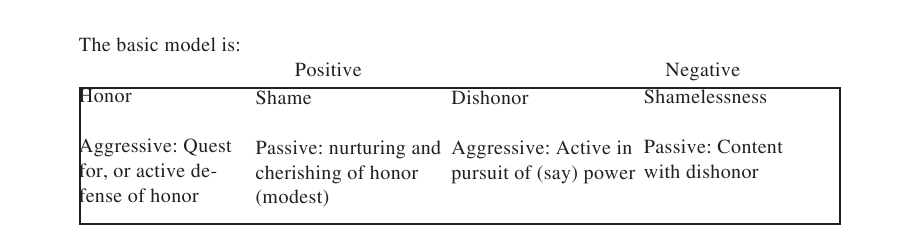
The Greco-Roman world was, among other things, what we call an “honor-shame” society: that is to say, the getting and protection of honor was of prime importance to individuals and groups. What is honor? “Honor” in this connection is a combination of the worth that you have in your own eyes together with the worth that you have in the eyes of whoever is important to you—normally your family, the people around you, the legitimate rulers and so on; but perhaps in special circumstances something else—the gods, for example, as in the story of Antigone, who defied Creon in order to bury her brother Polynices. Both “inner” and “outer” honor are necessary. That is to say, if you claim honor for yourself but everyone else thinks you are dishonorable, you are just a fool. On the other hand, in Shakespeare’s Macbeth, Macbeth’s problem after he becomes king might be described by saying that he receives honor from others but he knows in his heart that he does not deserve it (in other words, because he is basically an honorable man, what he has done makes him feel shame). Lady Macbeth seems at first to have no such problem, which means that she is shameless in terms of an honor/shame society.
We should understand that “shame” is in itself something positive and healthy. It is like feeling pain when you try to pick up something that is too hot: it is what a healthy person ought to feel when experiencing dishonor or acting dishonorably. “Shame,” in other words, is connected with proper modesty.
299
Of course the ancient “honor/shame” society (pagan and Jewish) was what we call “patriarchal.” This meant that the normal (though not invariable) role for a man was to be aggressive and active in pursuing honor; the normal (though not invariable) role of a woman was by her modesty to defend it.
It is worth reflecting that Jesus, the “carpenter of Nazareth” (Mark 6:3) would perhaps have inherited a certain position of “honor” and respectability within his family and his village community and have been expected to sustain that “honor.” His choosing an alternative role for himself, while “honorable” in the eyes of disciples, could easily have been seen as deeply “dishonorable” by others—involving as it did a rejection of family setting and town setting. Perhaps such a sense of “shame” should be seen behind both the traditions of family strain (3:21, 31-35; John 7:3-9) and the tradition of Jesus’ rejection at Nazareth (Mark 6:1-6; Luke 4:16-31).
Patronage
Closely linked to the question of shame/honor was the “patron/client” structure of ancient society. It was the (honorable) role of the patron to convey protection, favor, and other types of benevolentia (“benevolence”) to his or her client (Latin: cliens, clienta) whose (honorable) role is to render support, loyalty, and other appropriate marks of obligatio (“obligation”) to the patron. In Greco-Roman society the wealthy and powerful gained prestige and honor by the extent of their patronage and by the number and well-being of their clients. A really wealthy person might be “patron” of a whole city, or endow massive public works. In return the city would (as a matter of honor) show its “obligation” by putting up statues and memorial inscriptions, and conferring titles upon the patron like benefactor or sacerdos publicus (a “priest of the people”). It has been said that benevolentia/obligatio was the economic glue that held the Roman Empire together. The system began to erode when people no longer sought the “honor” that came from being “benefactors.” When they began to be satisfied to invest their wealth purely in personal acquisition, then the empire began to collapse. This was the case with the rich and powerful and their dependents; but of course each “household” also constituted a network of patronage, with the head of the household himself (or occasionally herself) “patron” of all other members. This required an extended network of wife, children, freepersons, and slaves.
The early Christian movement depended on a network of support from patrons. Jesus and his disciples are shown as the recipients of such support from (presumably) wealthy women such as Mary of Magdala and Joanna the wife of Herod’s steward who traveled with him (Luke 8:1-3). Paul speaks of Phoebe as his patron in the letter to the Romans (16:1-2; Greek: prostatis, NRSV “benefactor”), and in the Book of Acts we see Lydia, a wealthy businesswoman from Thyatira, apparently playing a similar role (Acts 16:14-15).
300
End of Chapter
Christianity questioned the Roman system of patronage back
This subject is never discussed, and indeed no such thing ever happened.
Epicurean and Jewish groups back
As did everyone else. Why mention just these two groups?
Or at least none... back
An important qualification. There was a very good official postal service in the Roman empire.
Euodia back
Elitish male-chauvinist pig!
Recent study back
A citation urgently needed.
Cicero used a secretary named Atticus back
Cicero did no such thing. Titus Pomponius Atticus was a wealthy friend of Cicero, and we have a large number of letters that Cicero wrote to him. But to call him a secretary is a mistake on the same order of crassness as to call the BVM Jesus' wife, not his mother.
Atticus certainly helped Cicero publish some of his books, and it would be charitable to believe that the writer thinks he remembers secretary instead of publisher from his college days. Cicero's secretary was a slave named Tiro, who invented shorthand.
But the fact that such an error can occur in the EFM text makes me wonder how reliable it is in general. If it makes mistakes like this on a subject that I happen to know something about, what mistakes are there in areas where I'm ignorant?
Do they fit? back
This is circular.
Contingent back
What means this?
History is valuable back
I'm not sure what this means, but I don't think I like it.
clienta back
clienta isn't a word in Latin or in English. I hope the writer didn't think it was the feminine of cliens. That's cliens again. Clientela is a word.
OK sorry - I looked it up. Clienta does exist as meaning a female client, but it's very rare. Cliens would be normal.
Honor and Shame back
I'm not sure how true this is of Roman society, and if true how relevant. The unexpanded reference to the Antigone of Sophocles reinforces my belief that the writer is drawing, without benefit of book, on the memory of bright college days.
Patronage back
It's Friday morning, I have to go out of town, so I won't write the full essay here, but will talk about it on Sunday. The patron/client relationship was an even bigger deal than the writer suggests. It controlled everything, but was largely a matter of status, not honor. Everyone was someone's client. All but the very lowest ranks of society were someone's patron. All the way up to the emperor, the capo di tutti capi, one might say.
A network of support back
This may actually be what the writer is talking about at the top with "Christianity questioning the Roman system of patronage." Certainly the early church was supported by rich people, but we don't see much evidence of a patron/client relationship.